From SFDR to SFDR 2.0 - and what this means for investors
Why Was Reform Needed?
On 20 November 2025, the European Commission approved a major legislative overhaul of the Sustainable Finance Disclosure Regulation, better known as SFDR 2.0.
To understand why the EU is reshaping the framework in the first place, we must look back at SFDR’s original mission. The first introduction of SFDR in March 2021 marked a decisive step toward alignment between EU’s climate goals and the financial markets.
The establishment of SFDR followed by a period of strong growth in sustainable and impact investing across Europe. During these years, the EU positioned itself as a frontrunner in sustainable finance, significantly outperforming global markets in both assets' holdings and capital inflows. In the early years of SFDR, the EU sustainable funds showed impressive growth of 13% of the total European investment fund market between 2019 and 2025.
In 2025, the EU markets started experiencing challenges across all investment KPIs. However, the underlying long-term momentum suggests that inflows are likely to bounce back as conditions stabilise. This recovery isn’t happening in isolation, with the global sustainable finance market projected to grow at an annual growth rate (CAGR) of 21.30% from 2026 to 2034. These findings suggest that interest in sustainable investment is not just a short-term spike but rather here to stay.
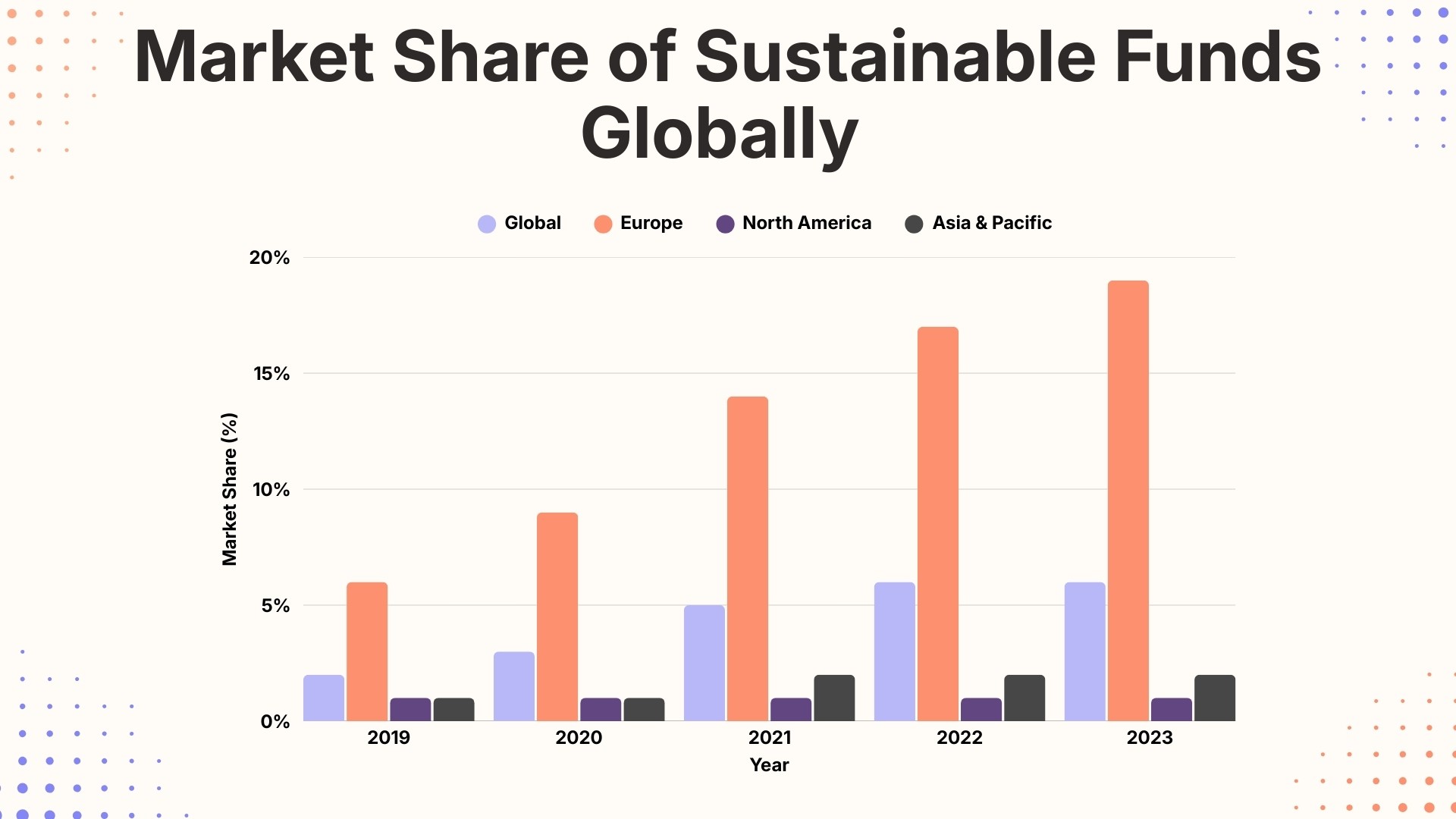
Data Extracted from the Association of the Luxembourg Fund Industry
As the market evolved, SFDR needed to become clearer and more consistent to be functional. However, while strong inflows and market leadership within the EU impact and sustainable funds persisted, the growing trend could not be directly linked to SFDR, with evidence pointing to a growing systemic issue within SFDR.
Research indicates that Article 8 and 9 funds under SFDR struggled to translate inflows into meaningful sustainability outcomes, such as portfolio-weighted carbon emissions. Articles 8 and 9 began functioning as de facto categories, despite never being designed as such. This led to inconsistent supervision, differing interpretations across Member States, and growing ambiguity for both investors and asset managers. A Harvard Law analysis indicated that investors could already infer sustainability characteristics from fund names and mandates alone, with SFDR disclosures providing little new information and, in many cases, increased confusion due to inconsistent interpretation.
Key shifts shaping the work
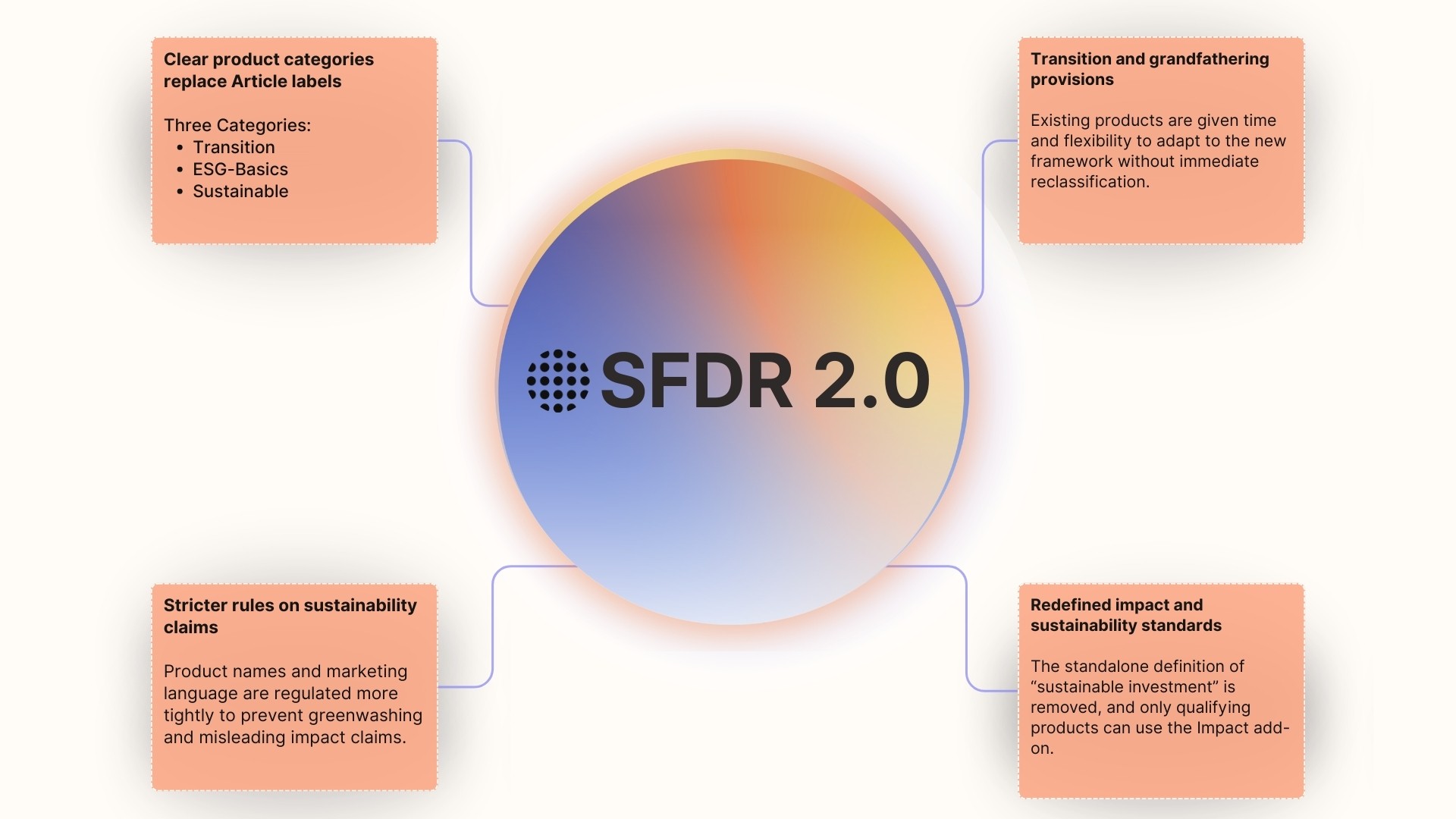
SFDR 2.0 simplifies the system by cutting back on overly complex requirements and allowing financial institutions to operate more efficiently. This gives investors clearer, more comparable information about sustainability-linked products.
Transition, ESG Basics & Sustainable
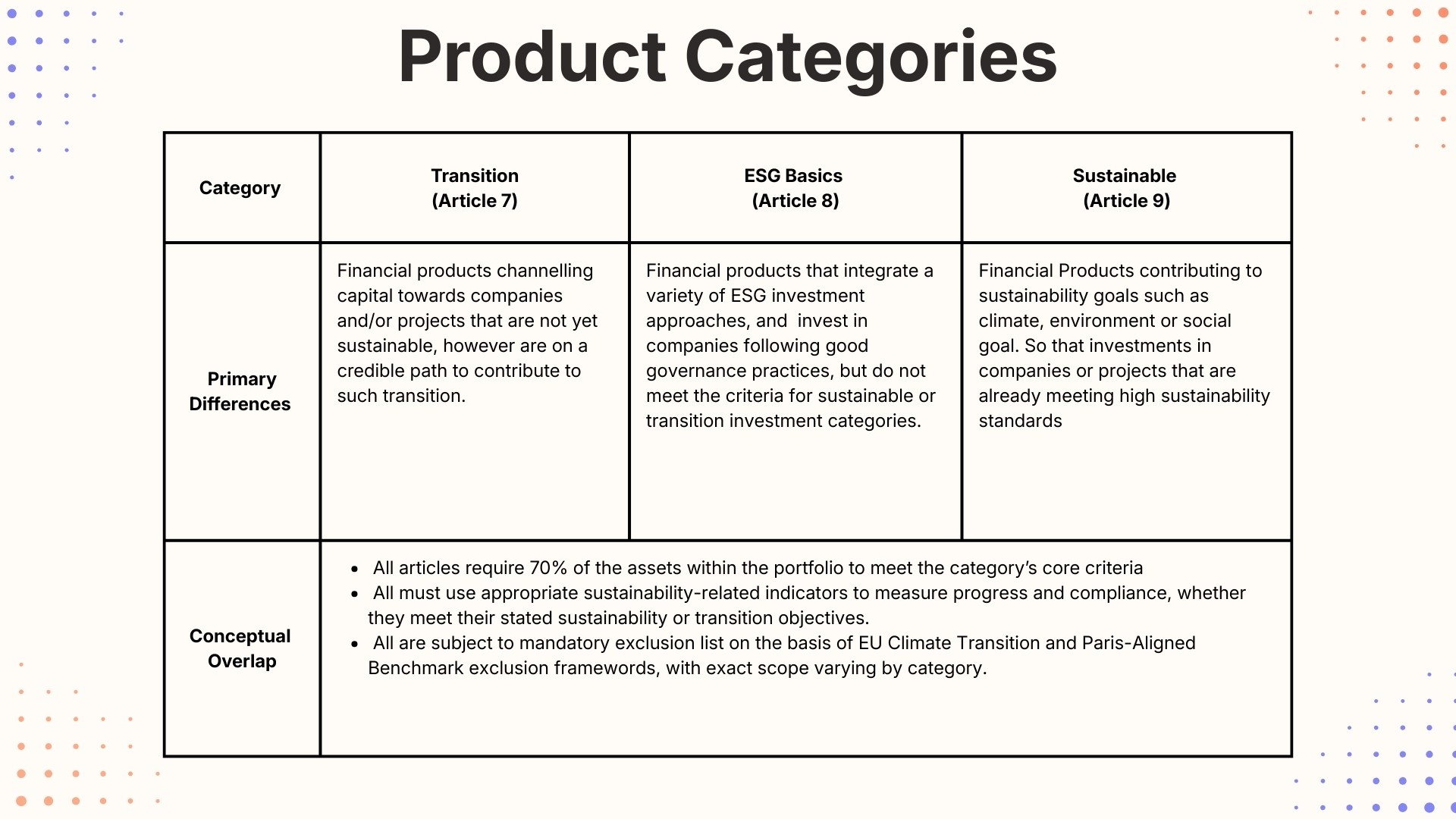
The central change is the transition from a disclosure only to a product categorisation system. The reform eliminates the “light” and “dark” green Articles 8 and 9. Introducing three product categories, Transition, ESG Basics, and Sustainable as replacement product categories that are designed to give investors a more intuitive way to sort funds by their level of sustainability. For instance, how well they contribute to sustainability goals such as climate, environment, or social goals, or how well they meet existing sustainability standards. So, let’s break them down one by one.
Article 7: Transition Products
Financial products channeling capital towards companies and/or projects that are not yet sustainable, however, are on a credible path to contribute to such transition. The primary goal is to support companies or activities with more sustainable environmental or social performance.

Qualification Criteria:
Article 8: ESG Basics
Products that integrate a variety of environmental, social and governance (ESG) factors into investment decision but do not meet the criteria of the Transition or Sustainable product categories. Funds focus on best-in-class performers on a given ESG metric, pursuing financial returns while excluding the worst ESG performers.
Qualification Criteria:
Article 9: Sustainable Products
Products meaningfully contribute to a measurable objective related to sustainability factors, such as climate, environment, or social goals. Through investments in companies or projects that are already meeting high sustainability standards. These products are designed to drive capital into projects that actively create measurable, positive contributions to sustainability outcomes.
Qualification Criteria:
9a Combination Category
The combination category is designed for funds that integrate or combine multiple of the new SFDR 2.0 categories. In practice, it covers products that invest in, or otherwise bundle, Transition, ESG Basics or Sustainable products together. The product fits within the category if they still meet the 70% minimum investment threshold. Additionally, for this product class, transparency of composition, objectives, and exclusions is key.
Use of the “Impact” label: criteria and conditions
This secondary category acts as a shortcut for investor communications, developing stricter criteria for the use of the “impact” label under SFDR 2.0. Which now serves as a clear signal to investors that any fund claiming impact must meet higher sustainability standards and adhere to stricter requirements around its objectives, theory of change, and impact reporting.
The product with the impact label goes beyond ESG integration, with the core objective of delivering a specific, positive, and measurable environmental or social outcome. Given the nature of the goal, this product label is only available for Sustainable and Transition Products, with ESG Basics being excluded. To qualify, the product must display clear intentionality linked to concrete objectives, how the given set of activities will achieve the goal and back this with an impact measurement, managing and reporting framework.
Need to match your investments with SFDR?
Reach out for a demo of our impact measurement software.
PAIs: revised approach
PAI framework also moved from broad entity-level reporting towards product-level disclosure, simplifying the reporting process and making funds easier to compare. Given the constantly changing nature of large portfolios, the calculated impact within the entity level of PAI was often complex, difficult to interpret, and made it challenging to compare portfolio performance with market benchmarks.
Removing the entity-level PAI allows investors to focus on product level PAI, which is the disclosure of any negative sustainability impact associated with a specific financial product. Instead of evaluating performance on a portfolio-wide level, the evaluation focuses on funds or financial product on an individual level. This is both simpler and easier to benchmark and compare across the market.
The revised PAI framework is directly tied into the newly developed product categories, specifically making it mandatory for Transition and Sustainability products. At the same time, the reporting procedure is simplified as well. Funds are now only required to identify those PAIs that are relevant to their strategy, explain how these impacts are being mitigated, and verify their claims through data providers or clearly defined internal methodologies. This targeted approach reduces unnecessary complexity by improving consistency in reporting and making sustainability impacts easier to compare across funds.
Clearer framework for sustainable finance
SFDR 2.0 marks a shift from complex reporting to a clearer and simplified framework for investing and sustainable finance. The most significant change is the move from a disclosure-only regime to a defined product categorisation system, centered around Articles 6, 8, and 9. By tightening rules around sustainability and impact-related communications, the regulation improves comparability, reduces ambiguity, and strengthens protection against greenwashing for investors and financial institutions.
Need help understanding the impact of your investment portfolio, aligned with SFDR?
Our AI-powered Impact & Sustainability Software help you align with key frameworks efficiently and transparently.
Book a demo to see how we can help you.